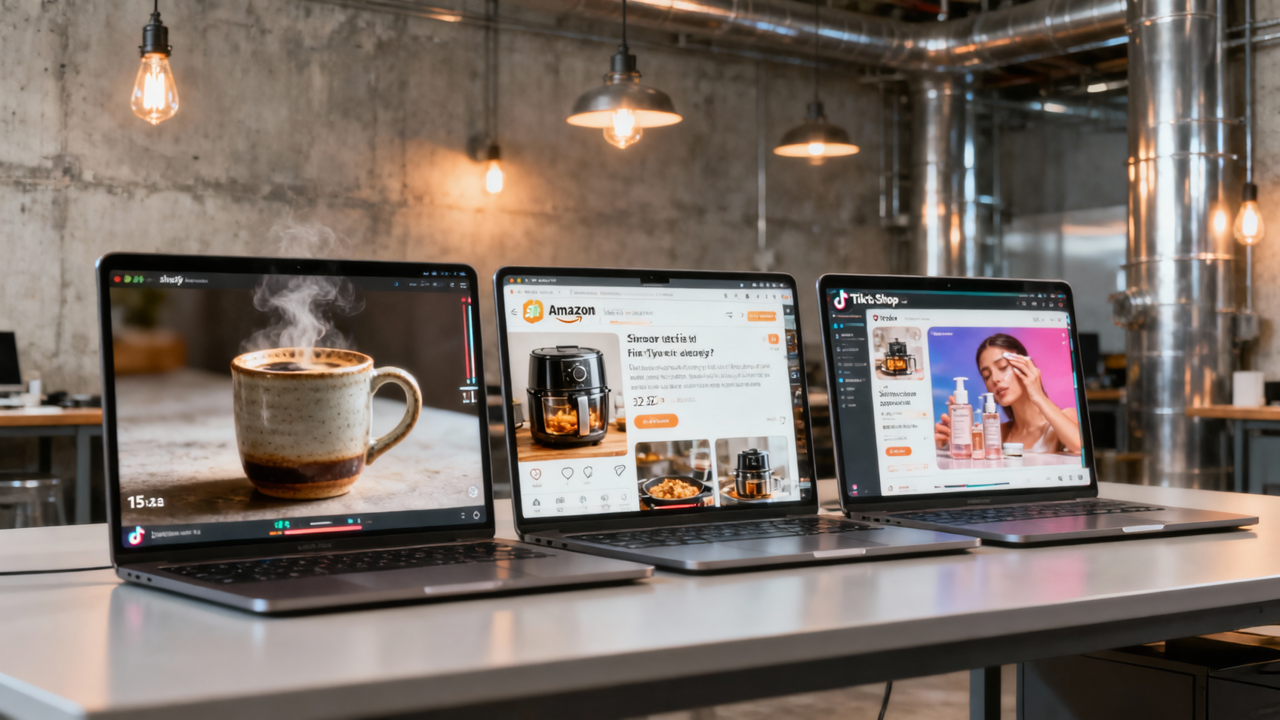
Ecommerce Video Ads in 2026: What DTC Brands Need to Win on Shopify, Amazon & TikTok Shop
In 2026, the average DTC customer scrolls past *seven* product listings before pausing — and they only stop for one thing: motion. Not flashy animations or autoplay audio, but authentic, benefit-driven ecommerce video ads that answer *"Why this? Why now? Why me?"* in under three seconds.
Static images still have a place — especially for catalog feeds and print assets — but video is now the default language of conversion across every major sales channel. According to Shopify’s 2026 Merchant Pulse Report, stores using video on product pages saw a 34% higher add-to-cart rate than those relying solely on images. On Amazon, ASINs with at least one 15–30 second video saw 22% more click-throughs from search results. And on TikTok Shop, where 78% of shoppers discover new brands via short-form video, top-performing sellers now allocate over 60% of their ad budget to native video creatives.
So how do lean, agile DTC teams — often operating with 2–5 person marketing squads — keep up?
The answer isn’t hiring a production studio. It’s strategic automation — paired with human-led creative direction.
Why Video Works (and Why ‘More’ Isn’t Better)
Video doesn’t convert because it’s shiny. It converts because it compresses context:
- **Demonstration** → “How does this fit?”
- **Social proof** → “Do others love it like I hope to?”
- **Scarcity + urgency** → “Is this variant still in stock?”
- **Cross-border clarity** → “Will this ship to Germany in under 9 days?”
But volume ≠ velocity. In Q1 2026, 63% of DTC brands tested video ads — yet only 29% refreshed them monthly. Stale video performs worse than no video: TikTok’s algorithm downranks repeated creatives after 14 days of identical engagement patterns, and Amazon’s A9 system deprioritizes listings with outdated video thumbnails.
That’s where *scalable iteration* becomes your unfair advantage.
Platform-Specific Video Requirements (2026 Edition)
### Shopify Stores
- **Ideal length**: 15–22 seconds (looping, silent-first)
- **Key placements**: Hero section, product page above-the-fold, cart abandonment pop-ups
- **Pro tip**: Embed subtle localization cues — e.g., currency toggle in corner, EU-compliant sizing labels — directly in video frames. Tools like Seedance 2.0 let you generate variants for DE/FR/ES markets from one English script in under 90 seconds.
### Amazon
- **Max length**: 30 seconds (6MB file size limit; H.264 MP4 only)
- **Critical specs**: 1080p minimum, center-framed main subject, no watermark overlays
- **What works in 2026**: Problem/solution framing (“Tired of tangled cords?” → quick cut to magnetic cable wrap snapping into place), not lifestyle montages. Bonus if your video includes a clear CTA like “Tap ‘Add to Cart’ now” — Amazon’s new voice-enabled shopping feature reads these aloud during playback.
### TikTok Shop
- **Format**: 9:16 vertical, 9–16 seconds ideal
- **Sound-on expectation**: 89% of users watch with audio enabled; prioritize natural voiceover or trending audio *with brand-aligned tone*
- **New in 2026**: TikTok’s ‘Shop Spotlight’ carousel now surfaces shoppable video clips *before* the product page loads — meaning your first frame must telegraph value *without text*. That’s where AI-generated video shines: Seedance 2.0 renders clean, expressive product close-ups with dynamic lighting and zero stock-footage clichés.
Real Ecommerce Use Cases — Not Theory
**Case 1: Sustainable Activewear Brand (US → EU Cross-Border)**
A Portland-based DTC label launched in Germany using Shopify Markets. Instead of translating static banners, they used Seedance 2.0 to auto-generate localized video variants: same model, same fabric close-up, but with German voiceover, metric sizing callouts, and background music licensed for EU territories. Result: 41% lower cost per acquisition vs. English-only video, and 2.3× longer session duration on German-language product pages.
**Case 2: Niche Home Appliance on Amazon US & CA**
A compact air fryer brand ran identical videos on both marketplaces — until noticing CA buyers engaged 37% longer when videos included bilingual packaging shots (English/French). They re-ran the campaign using Seedance 2.0’s dual-text overlay feature, generating compliant CA variants in bulk. ACOS dropped 18%, and negative reviews about language confusion fell to zero.
**Case 3: Skincare Startup Testing TikTok Shop**
Instead of filming 50 SKUs, they fed Seedance 2.0 high-res product images + ingredient benefits + target audience notes (“25–34yo, sensitive skin, values clinical transparency”). The tool generated 12 unique 12-second clips — each highlighting a different hero ingredient with subtle skin-texture animation and verified INCI naming. One clip went viral organically, driving $220K in direct TikTok Shop sales in 72 hours.
Beyond Generation: The Workflow That Scales
Great ecommerce video ads aren’t made — they’re *orchestrated*. Your 2026 workflow should include:
Cross-Border Considerations You Can’t Ignore
Video isn’t just translated — it’s *transcreated*. A gesture that signals trust in Japan may read as aggressive in Brazil. Humor rarely localizes. And regulatory markers (like CE marks or Health Canada disclaimers) must appear *visually*, not just in description fields.
Seedance 2.0 supports region-aware generation: feed it your target country, and it adjusts visual pacing (faster cuts in South Korea, slower reveals in Italy), selects culturally resonant color accents, and auto-inserts required compliance badges — all without manual editing.
Final Thought: Video Is Infrastructure Now
In 2026, ecommerce video ads aren’t a ‘nice-to-have’ campaign layer. They’re part of your product’s digital infrastructure — as essential as your SKU number or shipping calculator. The brands winning right now aren’t those with the biggest budgets. They’re the ones treating video like code: modular, testable, version-controlled, and built for iteration.
Start small. Pick one high-intent product. Generate three Seedance 2.0 variants — one for Shopify, one for Amazon, one for TikTok Shop. Run them for 10 days. Measure what moves the needle: time-on-page? scroll depth? share rate? Then scale what works.
Because in the age of attention scarcity, your best ad isn’t the most expensive one. It’s the one your customer *chooses* to watch — twice.