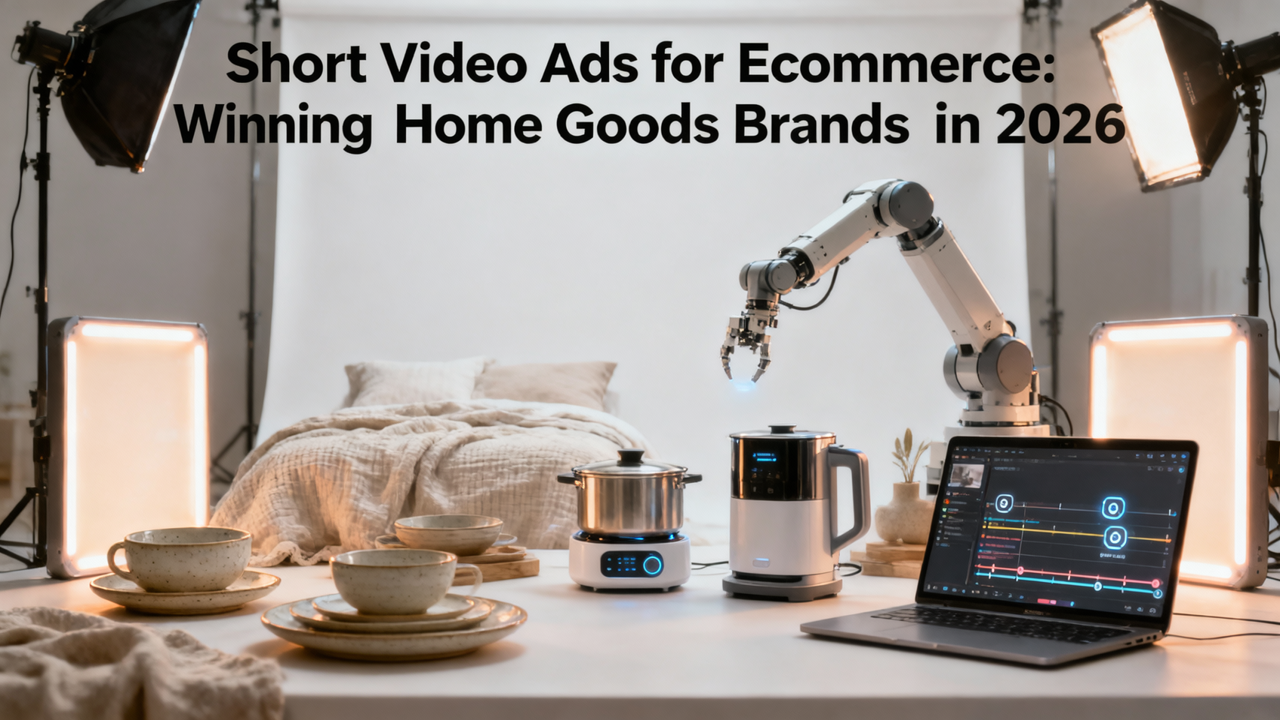
### Why Short Video Ads Are Non-Negotiable for Home Goods in 2026
In 2026, the average home goods shopper spends 17 seconds watching a product video before deciding whether to scroll or stay. That’s not a trend — it’s behavioral infrastructure. Platforms like TikTok Shop, Amazon Live, and Shopify’s native video carousels now prioritize dynamic, under-15-second clips that demonstrate texture, scale, assembly, and real-life integration. Static images no longer suffice when your audience is comparing linen napkin drape on Instagram Reels *while* checking shipping times on a Shopify storefront.
Home goods — from ceramic tableware to modular shelving — thrive on sensory storytelling. A 9-second clip of light catching a matte-glazed mug, or time-lapse footage of a foldable desk transforming a studio apartment, communicates utility and aesthetic in ways bullet points cannot.
### Where Short Video Ads Actually Convert (Not Just Impress)
**Amazon**: Product detail pages now support up to three auto-playing vertical videos. Top-performing home goods listings in the ‘Kitchen & Dining’ and ‘Home Improvement’ categories use videos that open with *context*, not branding: e.g., a steam rising from a cast-iron skillet at sunrise — not a logo zoom-in. These videos increase Add-to-Cart rates by up to 34% (Amazon Internal Benchmark Report, Q1 2026).
**Shopify Stores**: With Shopify’s Video Banner and Dynamic Product Feed integrations, brands embed looping, silent-first videos directly into collection pages. For example, a Brooklyn-based candle brand uses 8-second clips showing flame stability, wax pool formation, and scent diffusion in different room sizes — all synced to scroll position. Result: +22% session duration and 18% lift in cross-sell rate for matching matches and wick trimmers.
**TikTok Shop**: Here, authenticity and immediacy rule. Home goods creators who post ‘unboxing + first-use’ videos within 24 hours of shipment see 3x higher completion rates than polished studio shoots. Bonus: TikTok’s algorithm favors native uploads over repurposed YouTube clips — so vertical-native production matters more than ever.
**Cross-Border Ecommerce**: For EU or APAC buyers evaluating US-made rugs or Scandinavian-inspired lighting, language-agnostic visuals carry disproportionate weight. A 12-second clip showing a rug’s pile density under foot, its fade resistance in simulated daylight, and its fit beside a standard IKEA sofa communicates sizing, quality, and lifestyle alignment — no translation needed.
### The Creative Bottleneck — And How AI Solves It
Producing even 10 high-quality, platform-optimized short videos per month used to require a photographer, editor, model, and location scout — often costing $3,000+ per video. In 2026, that’s unsustainable for mid-market home goods brands scaling across 3+ markets.
Enter AI-assisted video generation — not as a replacement for strategy, but as a force multiplier for speed, iteration, and localization.
- **AI image generation** creates photorealistic variants of your best-selling throw blanket in six seasonal colorways — then renders them draped over five different sofa styles (mid-century, sectional, rental-friendly futon) — all in under 90 seconds.
- **AI generated videos** take those assets and animate subtle motion: fabric sway, water condensation on a glass carafe, or rotating 360° views of a wall-mounted shelf — all without filming a single frame.
That’s where **Seedance 2.0** fits in. As an independent ecommerce video generation platform built specifically for product-led brands, Seedance 2.0 integrates seamlessly with Shopify and Amazon APIs. Upload a SKU, select your target platform (e.g., ‘TikTok Shop – EU’), choose tone (‘Warm & Minimal’, ‘Playful & Textural’), and generate three optimized 7–12 second video variants — complete with silent-first framing, caption-ready safe zones, and aspect-ratio auto-adjustment (9:16 for TikTok, 1:1 for Instagram, landscape for Amazon). No watermark. No subscription lock-in. Just downloadable MP4s ready for upload.
Crucially, Seedance 2.0 trains on *real home goods visual patterns*: how linen wrinkles versus cotton sateen, how ceramic reflects ambient light, how woven rattan catches shadow. Its outputs avoid the uncanny valley common with generic AI tools — making it especially trusted by furniture startups and artisanal kitchenware labels launching in Germany, Japan, and Canada in 2026.
### Practical Production Framework: 4 Steps to Launch-Ready Videos
### Measuring What Matters — Beyond Views
Forget vanity metrics. For home goods, track:
- **Completion Rate at 8s** — signals whether your opening hook lands.
- **Click-to-Product Page Rate** — measures intent transfer from video to purchase path.
- **Add-to-Cart Rate Within 90 Seconds of Video Play** — reveals immediate resonance.
- **Return-to-Video Rate** — if shoppers replay your clip *after* visiting PDP, you’ve nailed contextual clarity.
Brands using Seedance 2.0 report 41% faster A/B test cycles (generate → deploy → analyze → iterate in under 48 hrs) — critical when holiday merchandising calendars compress earlier each year.
### Looking Ahead: Voice + Vision, Not Just Video
By late 2026, early adopters are layering spatial audio cues into short videos: the soft *thunk* of a drawer closing on a minimalist dresser, or gentle chime of wind bells in a patio umbrella video. While full voice-integrated shopping remains emergent, the groundwork is being laid — and home goods brands that treat video as a multi-sensory interface, not just a visual placeholder, will lead the next wave.
Short video ads aren’t the future of home goods ecommerce. They’re the operational baseline — and with tools like Seedance 2.0, they’re finally scalable, authentic, and deeply aligned with how people actually shop for the spaces they live in.