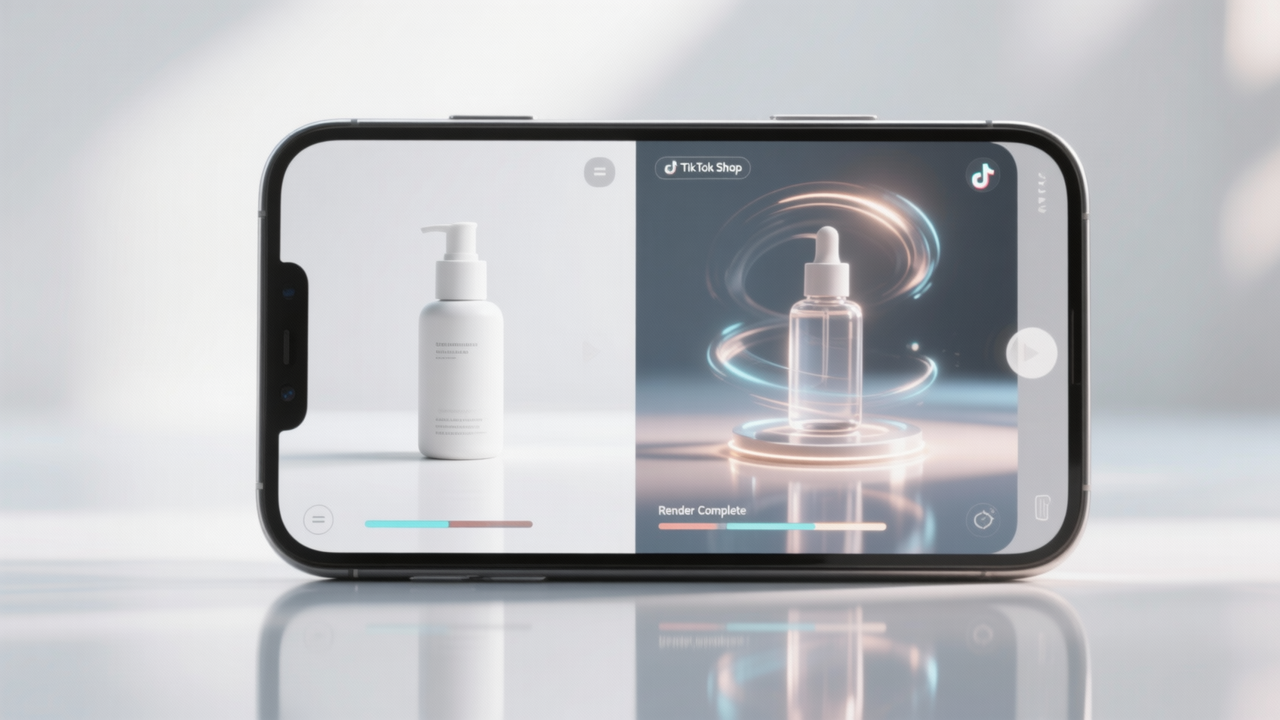
Turn Product Images to Video in Seconds: TikTok Shop Sellers’ 2026 Edge
In early 2026, TikTok Shop reported that listings with at least one short-form video outperformed image-only listings by **3.2× in average watch time**, **2.8× in click-through rate**, and drove **27% more add-to-cart actions** — even when the video was under 5 seconds long. The secret? Not filming on set. Not hiring editors. Not stitching clips in CapCut. It’s *product image to video*: transforming a single high-res JPEG or PNG into scroll-stopping motion — instantly.
If you’re selling on TikTok Shop — especially across cross-border markets like the US, UK, UAE, or Southeast Asia — this isn’t just a nice-to-have. It’s your fastest path to standing out in an algorithm that rewards authenticity *and* velocity.
Why Static Images Are Losing Ground in 2026
TikTok’s 2026 Commerce Index shows that users now spend **41% less time scanning static product grids**, and over 68% of shoppers abandon a listing if the first visual isn’t moving within 0.8 seconds. That’s faster than a blink.
This shift impacts *all* ecommerce channels — but TikTok Shop is uniquely sensitive because:
- Its feed is 100% video-first (even search results prioritize video thumbnails),
- Its recommendation engine weights dwell time and replay rate *more heavily* than ever,
- And its cross-border buyers rely heavily on visual context — not just specs — to assess quality, scale, and texture.
A flat image of a ceramic mug doesn’t show weight. A still of a wireless earbud case doesn’t demonstrate portability. But a 3-second zoom-and-rotate video does — without needing a studio.
How ‘Product Image to Video’ Actually Works (No AI Jargon Needed)
At its core, ‘product image to video’ uses generative AI to infer depth, lighting consistency, and natural motion from a single 2D image. Think of it as teaching the AI: *“Here’s what the object looks like head-on — now imagine how light catches its curve, how it would rotate on a turntable, how fabric drapes or metal reflects.”*
The output? A smooth, silent (or optionally audio-enhanced), 3–6 second MP4 — optimized for TikTok’s vertical feed (1080×1920), autoplay-friendly, and ready to upload in <60 seconds.
### ✅ What works best:
- Clean, well-lit, isolated product shots (white or subtle gradient background),
- Front-facing or ¾ angle (no extreme overhead or low-angle distortion),
- High resolution (≥1200px on the longest side),
- Minimal shadows or reflections that could confuse depth estimation.
### ❌ What slows things down:
- Crowded lifestyle scenes (e.g., “woman holding bag in café”),
- Multiple products in one frame without clear separation,
- Low-light or heavily compressed JPEGs.
Real Ecommerce Use Cases — From TikTok Shop to Amazon & Beyond
### 🎯 TikTok Shop: Your First 3 Videos Per Listing
Most top-performing sellers now deploy a *video triad*:
These aren’t replacements for UGC — they’re *on-ramps*. They get the scroll to pause. Then UGC or testimonials take over.
### 🌐 Cross-Border Sellers: Localize Without Reshooting
Selling the same bamboo cutting board in Germany, Japan, and Mexico? You don’t need three photo shoots. With Seedance 2.0, generate one base video from your flagship image — then use its built-in localization tools to:
- Swap background color to match regional aesthetic preferences (e.g., muted taupe for EU, soft pink for JP beauty niches),
- Adjust motion speed (slower pans preferred in mature markets; snappier cuts for LATAM),
- Export variants in local aspect ratios (e.g., 9:16 for TikTok, 1:1 for Instagram Shops, 16:9 for Amazon Live banners).
No translation API needed — just visual tuning.
### 🛒 Shopify & Amazon Sellers: Fill Gaps, Not Galleries
Shopify merchants using PageFly or GemPages report a 19% lift in time-on-page when replacing hero image carousels with auto-playing video loops. On Amazon, where A+ Content supports MP4s, sellers using image-to-video for comparison visuals (“Before/After stain removal”, “Folded vs. Unfolded dimensions”) saw 22% higher conversion on detail pages.
Pro tip: Generate *one* polished video per SKU — then repurpose frames as stills for your Amazon main image, Shopify thumbnail, and Pinterest pin. One input, five outputs.
Why Seedance 2.0 Fits TikTok Shop Sellers’ Workflow
Seedance 2.0 wasn’t built for agencies or enterprise teams. It was designed *by* ecommerce operators *for* solo sellers and micro-brands shipping internationally.
Here’s what makes it different in 2026:
- **One-click batch mode**: Upload 50 product images → generate 50 TikTok-optimized videos in under 9 minutes (no queueing),
- **TikTok Shop auto-tagging**: Outputs include optional metadata tags like `#tiktokshop`, `#smallbiz`, `#crossborder` — ready for bulk upload via Seller Center CSV,
- **Zero watermark policy**: Unlike many AI tools, Seedance 2.0 delivers clean MP4s — no logos, no forced attribution,
- **Offline-safe preview**: Simulate how your video renders on mid-tier Android devices (critical for SEA and LATAM buyers),
- **GDPR- and ADP-compliant processing**: All image data is deleted after generation — no storage, no retraining.
It integrates cleanly with common workflows: drag-drop from Google Drive or Dropbox, export directly to TikTok Business Suite, or push to your Shopify media library via Zapier.
Getting Started — Your First Video in Under 2 Minutes
That’s it. No account required for trial. No credit card. You’ll see measurable lift in CTR within 48 hours — especially on new listings.
Bonus: Pair With What’s Already Working
Don’t replace your best-performing UGC. *Amplify it.* Use Seedance 2.0 to:
- Convert customer-submitted photos (with permission) into mini-videos for your catalog,
- Turn competitor product images (publicly available) into comparative demo videos — for internal training or private seller briefings,
- Generate placeholder videos while waiting for professional photography — keeping listings live and algorithmically active.
In 2026, speed isn’t about rushing. It’s about removing friction between inspiration and upload — so your product speaks before the shopper scrolls past.
The future of ecommerce video isn’t filmed. It’s generated — intelligently, ethically, and instantly. And for TikTok Shop sellers balancing inventory, logistics, and localization, that changes everything.